庞德强,男,汉族、大学,中共党员,退休干部、政府专业拔尖人才。祖籍四川阆中市。
二、主要艺术协会职务、职称、杈威网络数据库。
<一>、职务:中国楹联协会会员、中国书协会员、中国书画联谊会会员、中国东方艺术研究会艺术研究员、中国孔子美术馆副馆长、人民大会堂首席艺术顾问、中央新影“中学生”频道《美育视界》栏目艺术顾问,法国巴黎美协会员(中方艺术家)……。
<二>、权威网络数据库入录资格:
1、劳动和人事部人才资源数据库入录专家。
2、中国文联中华文艺网资源数据库入库书法家(2025年3月)。
3、文旅部资源数据库入库书法家(2025年8月)。
<三>、职称:中国立体书法创始人、国家高级书法师、国家一级书法师。
三、主要荣誉、获奖:
<一>、荣誉
1、吉尼斯世界纪录
2、世界和平使者
3、世界文化名人
4、共和国德艺双馨艺术家
<二>、获奖(国际国内金银铜以及其它奖项近百项)
1、世界非遗一等奖
2、纪念邓小平诞辰百周年全国书法展一等奖
3、纪念辛亥革命百周年海峡两岸书画名家交流展特别荣誉奖。
四、主要书法系列作品代表作
<一>、独创立体书法:《龙》《梦》《中国梦》《缘》《山舞银蛇》《虎》《江山多娇》……
<二>、独创碑拓书去:小楷《伟人颂》小楷《云湖赋》《辛亥百年赋》《 毛泽东赋》《滕王阁序》,隶书《岳阳楼记》《天道酬勤》…… ……
<三>、独创变隶书,自创词赋作品自书《念奴娇.长江大桥》,四尺单横《融通四海》……
<四>、榜书:八尺《龙》、一丈二尺常规书法《龙》、40米长卷行草书《毛泽东词.沁园春.雪》……
<五>、悬空书法:行草《海纳百川》《龙腾虎跃》…… ……
<六>、刻石书法:立体书法行草书《龙》刻于长城西拔子段书画碑林。行草书《砺剑》《中国梦》、楷书《求真》《务实》;磁刻立体书法《中國梦》,独创碑拓书法自书自创排律小楷《伟人颂》载入吉尼斯世界纪录》……
<七>、常规书法;行草《海纳百川》《龙腾虎跃》《风华正茂》行草书毛泽东词《沁园春.雪》……
五、出版权威典籍:
<一>、合集百余部《世界文化名人录》《中国历代书法名家大辞典》《中国书法通史.近现代部份》《世界非物质文化遗产目录》《世界艺术大系_中国艺术》《中国收藏博览》《经典 · 传承》《世界非遗传承大典》…… ……
<二>、个人专集(10余册):
《世界艺术领军人物》《庞德强个人诗词书法作品集》《中华名家》《国际艺术家》……
<三>、政治、经济理论成果
1、《中国市场经济文论大典
2、中央党校《理论前沿》
3、《新疆党讯》
…… …… ……
<四>、电影、网络、报纸刊物、杂志(国际国内)
1、电影梦工场(专题记录片《水润墨雅 立本创新》
2、网络(国际国内数千余次)人民日报网、央视网、中国网、新华网、中国博物馆网、中国美术家网、中国收藏网…
3、国际报纸:美国侨报、芝加歌时报、日本、马来西亚华文报……
4、国内报纸:人民代表报、中国文化报、解放军报、中国商报、澳门日报、人民军队报、中国书画报、中国投资时报、新疆日报……
5、刊物:世界文艺、文化月刊、青年文摘、中国品牌防伪……
6、杂志:英国佳士德、军转民、精典杂志,全国中小学生教材 :书法 . 美术……
六、国际国内交流:
1、国际:美国、英国、法国、加拿大、澳大利亚、马来西亚、日本、韩国、泰国、新加坡……
2、国内:港、澳、台,全国20余省……
七、作品价值评估
2020年5月,书作被国家高级美术师职称评审委员会等评定为“国家高级书法师”,作品价值评估为:人民币每平方尺60000元。2022年3月,由国家文旅部、中国书画艺术品鉴定评估中心评估:8—15万元平方尺;可以接受中国书画交易中心2025年7月备案,当前市场直销人民币50000元/平方尺,随海内外市场直销实况调升润格价值;国际资质brics认证:人民币95000元—150000元平方尺,美元、欧元15000—30000元平方英尺,2022年之前未录,也不包括立体书法(立体书法系独创,国际国内史无前例。供需双方协议)。
八、相关资料:
(一)艺术追求:师古不泥,参悟大自然,捕捉自然灵性,创出自己的风格。
(二)、人生信念:
“人人都拥有一个太阳、成功之门为强者所开”入编《全国优秀格言集》。
(三)、百度查询:书法名家庞德强 立体书法创始人庞德强 庞德强影视专题片 《大家风范》《庞德强老师2020年“泼墨中华情专访”》《中华英才网独家专访》《中国网》《中国访谈》《名家对话》《中学生·美育视界-书法名家庞德强》,
庞德强·搜狗百科、书画家百科、抖音百科、百度百科、秒懂百科、国际名人百科。
审视庞德强先生的书法,犹如凝视一场静默的视觉爆炸。这位从四川阆中古城走出的艺术家,用六十载的笔墨修行,完成了一项近乎叛逆的壮举:他为传承千年的平面汉字,赋予了跃然纸上的第三维度。他的艺术生涯,是一场从蜀乡阆中的懵懂少年,为实现少年的梦,辗转来到伊犁唐布拉草原,从故乡积淀的国学国粹基础的淬练与政府专业领域的严谨逻辑,猛然闯入书法艺术的创新,从传统书法到未知疆域的研创立体书法的惊险跨界;更是一场以学者之思、匠人之心,对传统书写法则进行彻底空间解构的孤独远征。他不仅是中国书法界公认的“立体书法创始人”而且得到国家权威机构认定。‘更是一位以笔墨为手术刀,解剖并重组汉字空间基因的“视觉建筑师”。
立体书法的诞生,绝非灵光乍现的偶然,其背后是庞德强在时代激流与个人困境中长达数十年的艰难孕育。上世纪八十年代初,改革开放的春风在唤醒经济活力的同时,也催生了文化艺术的反思浪潮。庞德强敏锐地察觉到,传统书法在面临现代视觉冲击时显现的局限。然而,将二维的笔墨引向三维的想象,这条路上布满荆棘。它遭遇的不仅是“不伦不类”、“背离传统”的质疑,更源于技法与材料上的无先例可循。那是一次次在黑暗中的摸索,是宣纸与墨色无数次令人沮丧的失败对话。庞德强凭借其“国学”“国粹”的长期积淀私累的学术韧性与近乎偏执的探索精神,在无数个昼夜的实验与推倒重来中,逐步破解了如何在静态平面上营造动态景深、如何让笔墨线条产生物理抬升错觉的终极密码。这一过程,与其说是创新,不如说是一场在传统母体内部艰难分娩新生命的“艺术阵痛”。
庞德强所定义的立体书法,是一场深刻的美学范式转移。它绝非对传统书法的简单否定或肤浅的“3D化”,而是建立在深厚笔法功底之上的创造性转化。其核心在于,将中国书法固有的“筋骨”、“血肉”之说,从隐喻层面推向视觉实在。他以传统书法的笔意、结体、章法为灵魂,巧妙融入西方绘画的透视原理、雕塑的空间构成乃至光学的明暗效应。于是,一点一画不再仅仅是平面上的轨迹,而成为了塑造体量、构筑空间的“视觉构件”。墨色的浓淡干湿,被赋予塑造光影与质感的全新使命;线条的疾涩提按,则转化为控制空间进深与转向的隐形轴线。其代表作《龙》系列,将中国龙精神融合于中华民魂国魂,以世间万物与大自然的万千气象、以神州地理概貌与长诚文花聚合,以自身之豪气,万毫齐发,挥洒出气吞山河的八尺立体书法《龙》……。便淋漓尽致地展现了这种立体特质:笔势如蛟龙翻腾,墨韵似云霞蒸蔚,通过精妙的明暗过渡与结构穿插,观者仿佛能触摸到鳞甲的凹凸,感受到那股破纸欲出的磅礴气韵。而获得吉尼斯认证的悬浮装置《中国梦》,则将这种空间艺术推向了观念层面,使书法彻底摆脱案头尺牍的束缚,成为介入现实环境、对话古今未来的综合性艺术载体。
Pang Deqiang, male, Han nationality, university degree, Member of the Communist Party of China, retired cadre, government-level top professional talent. Native of Langzhong, Sichuan.
II. Major Art Association Positions, Professional Titles & Authoritative Database Listings
(I) Positions
- Member, Chinese Couplet Association
- Member, Chinese Calligraphers Association
- Member, Chinese Painting and Calligraphy Association
- Art Research Fellow, China Oriental Art Research Association
- Deputy Curator, Confucius Art Museum of China
- Chief Art Consultant, The Great Hall of the People
- Art Consultant, Aesthetic Education Vision column, Middle School Students Channel of Central New Film Group
- Member (Chinese artist), Artists Association of Paris, France
(II) Authoritative Network Database Entries
1. Expert in the Human Resources Database, Ministry of Labor and Personnel
2. Listed Calligrapher in the Resource Database of China Literary and Art Federation (March 2025)
3. Listed Calligrapher in the Resource Database, Ministry of Culture and Tourism (August 2025)
(III) Professional Titles
- Founder of Chinese Three-Dimensional Calligraphy
- National Senior Calligrapher
- National First-Class Calligrapher
III. Major Honors & Awards
(I) Honors
1. Guinness World Record
2. Messenger of World Peace
3. World Cultural Celebrity
4. Republic Artist of Virtue and Art
(II) Awards
Nearly 100 gold, silver, bronze and other awards at home and abroad, including:
1. First Prize, World Intangible Cultural Heritage
2. First Prize, National Calligraphy Exhibition Commemorating the 100th Anniversary of Deng Xiaoping’s Birth
3. Special Honor Award, Cross-Strait Famous Artists Painting and Calligraphy Exhibition Commemorating the 100th Anniversary of the 1911 Revolution
IV. Representative Calligraphy Works (Series)
(I) Original Three-Dimensional Calligraphy
Dragon, Dream, Chinese Dream, Fate, Mountains Dancing with Silver Snakes, Tiger, The Country is So Beautiful, etc.
(II) Original Stele-Font Calligraphy
Regular Script in Small Characters: Ode to the Great Man, Ode to Yunhu, Ode for the Centenary of 1911 Revolution, Ode to Mao Zedong, Preface to the Tengwang Pavilion
Official Script: Memorial to Yueyang Tower, Heaven Rewards the Diligent, etc.
(III) Original Transformed Official Script & Self-Composed Ci & Fu
Niannujiao · Yangtze River Bridge, Integration Through the World (four-foot horizontal scroll), etc.
(IV) Monumental Calligraphy
Eight-foot Dragon, 12-foot regular Dragon, 40-meter long cursive script Mao Zedong: Snow · To the Tune of Spring in a Garden, etc.
(V) Suspended Calligraphy
Cursive Script: All Rivers Run Into the Sea, Dragon Soars and Tiger Leaps, etc.
(VI) Stone & Magnetic Inscription Calligraphy
Three-dimensional cursive Dragon engraved in the Painting and Calligraphy Forest of Steles at Xibazi Section of the Great Wall.
Cursive Script: Forge Sword, Chinese Dream; Regular Script: Seek Truth, Be Practical.
Magnetically carved three-dimensional calligraphy Chinese Dream.
Original stele-font regular script in small characters Ode to the Great Man (self-composed & written) included in the Guinness World Records.
(VII) Regular Calligraphy
Cursive Script: All Rivers Run Into the Sea, Dragon Soars and Tiger Leaps, Full of Vigor and Talent,
Cursive Script of Mao Zedong’s poem Snow · To the Tune of Spring in a Garden, etc.
V. Publications & Authoritative Classics
(I) Collected Works (over 100 volumes)
World Cultural Celebrities, Dictionary of Famous Chinese Calligraphers Through the Ages, General History of Chinese Calligraphy (Modern & Contemporary Part), World Intangible Cultural Heritage List, World Art Series – Chinese Art, China Collection Expo, Classics · Inheritance, World Intangible Cultural Heritage Inheritance Ceremony, etc.
(II) Personal Monographs (more than 10 volumes)
World Art Leader, Selected Works of Pang Deqiang’s Poems and Calligraphy, Chinese Famous Artists, International Artist, etc.
(III) Political & Economic Theoretical Achievements
1. Collection of China’s Market Economy Essays
2. Theoretical Frontiers, Party School of the Central Committee
3. Xinjiang Party Newsletter, etc.
(IV) Media Coverage (Film, Internet, Newspapers, Magazines)
1. Film: Documentary Moist Ink & Elegance, Rooted Innovation by DreamWorks Film Studio
2. Internet: Thousands of reports at home and abroad, including People’s Daily Online, shturl.c, shturl.cc, Xinhuanet, China Museum Network, China Artists Network, China Collection Network, etc.
3. International Newspapers: China Press (USA), Chicago Times, Chinese newspapers in Japan, Malaysia, etc.
4. Domestic Newspapers: People’s Congress News, China Culture Daily, PLA Daily, China Business Herald, Macao Daily, People’s Army News, China Painting and Calligraphy News, China Investment Times, Xinjiang Daily, etc.
5. Periodicals: World Literature & Art, Cultural Monthly, Youth Digest, China Brand Anti-Counterfeiting, etc.
6. Magazines & Textbooks: Christie’s (UK), Military-to-Civilian Conversion, Classic Magazine, national primary and secondary school textbooks: Calligraphy · Art, etc.
VI. International & Domestic Exchanges
1. International: United States, United Kingdom, France, Canada, Australia, Malaysia, Japan, South Korea, Thailand, Singapore, etc.
2. Domestic: Hong Kong, Macao, Taiwan, more than 20 provinces across China.
VII. Work Value Evaluation
- In May 2020, certified as National Senior Calligrapher; works valued at 60,000 RMB per square foot.
- In March 2022, appraised by the Ministry of Culture and Tourism and China Painting and Calligraphy Art Appraisal Center: 80,000 – 150,000 RMB per square foot.
- Recorded at China Painting and Calligraphy Trading Center in July 2025: current direct market price 50,000 RMB per square foot (adjustable with market conditions).
- BRICS International Certification: 95,000 – 150,000 RMB per square foot; 15,000 – 30,000 USD/EUR per square foot.
- Prices above do not include three-dimensional calligraphy (original and unprecedented; priced by mutual agreement).
VIII. Related Information
(I) Art Pursuit
Learn from the past but not be rigidly bound by it; comprehend nature, capture its spirit, and create a unique personal style.
(II) Life Belief
“Everyone has a sun; the door to success opens for the strong.”
Included in Collection of National Excellent Mottoes.
(III) Online Resources
Searchable on Baidu:
Famous Calligrapher Pang Deqiang, Founder of Three-Dimensional Calligraphy Pang Deqiang,
Documentaries: Elegant Demeanor,
2020 Splashing Ink in China Interview,
China Talent Network Exclusive Interview,
China Talk, Famous Dialogues,
Middle School Students · Aesthetic Education Vision – Famous Calligrapher Pang Deqiang.
Listed on: Baidu Encyclopedia, Sogou Encyclopedia, Calligrapher Encyclopedia, Douyin Encyclopedia, Miaodong Encyclopedia, International Celebrity Encyclopedia.
To examine Pang Deqiang’s calligraphy is to gaze upon a silent visual explosion. Hailing from the ancient city of Langzhong in Sichuan Province, this artist has spent six decades cultivating his brush and ink, accomplishing an almost rebellious feat: he has endowed the millennia-old two-dimensional Chinese characters with a vivid third dimension that leaps off the paper.
His artistic career is a remarkable journey: from an ignorant young man in his hometown of Langzhong, driven by a childhood dream, he traveled far to the Tangbula Grasslands in Yili. He forged his foundation in traditional Chinese culture and national essence in his hometown, and developed a rigorous logical mind through his professional work in government, before making a bold incursion into innovative calligraphy. It was a daring crossover from traditional calligraphy into uncharted territory—the creation of three-dimensional calligraphy. It is also a solitary expedition, conducted with the mind of a scholar and the heart of a craftsman, to completely deconstruct the spatial structure of traditional writing. He is not only universally recognized as the Founder of Chinese Three-Dimensional Calligraphy and officially certified by national authoritative institutions, but also a visual architect who uses the brush as a scalpel to dissect and restructure the spatial genes of Chinese characters.
The birth of three-dimensional calligraphy was no sudden flash of inspiration. Behind it lay decades of arduous gestation amid the tides of the times and personal hardships. In the early 1980s, the spring breeze of reform and opening-up revitalized the economy and stirred a wave of reflection in culture and art. Pang Deqiang keenly perceived the limitations of traditional calligraphy when confronted with modern visual impact. Yet the path to transforming two-dimensional brushwork into three-dimensional imagination was fraught with thorns. He faced not only criticism of being “unorthodox” and “departing from tradition,” but also a complete lack of precedent in technique and materials. It was a process of groping in the dark, of countless frustrating attempts and failures between rice paper and ink.
Drawing on his long-term accumulation of traditional Chinese learning and national cultural essence, his academic resilience, and an almost obsessive spirit of exploration, Pang Deqiang experimented day and night, revising and restarting innumerable times. He gradually unlocked the ultimate code: how to create dynamic depth on a static surface, and how to produce the physical illusion of elevation in brush lines. This process was less an act of innovation than an “artistic labor pain”—painfully giving birth to a new life from within the womb of tradition.
The three-dimensional calligraphy defined by Pang Deqiang represents a profound paradigm shift in aesthetics. It is by no means a simple rejection or superficial “3D effect” applied to traditional calligraphy, but a creative transformation built on profound mastery of brushwork. Its core lies in elevating the traditional metaphors of “bones and sinews” and “flesh and blood” in Chinese calligraphy to tangible visual reality.
Taking the brush charm, structure, and composition of traditional calligraphy as its soul, his work subtly integrates the perspective principles of Western painting, the spatial composition of sculpture, and the light-and-dark effects of optics. Each dot and stroke is no longer merely a trace on a flat surface, but a “visual component” that shapes volume and constructs space. The thickness, dryness, and wetness of ink are assigned a new mission: to model light, shadow, and texture. The speed, friction, lifting, and pressing of strokes become invisible axes controlling spatial depth and direction.
His representative Dragon series embodies the spirit of the Chinese dragon and the soul of the Chinese nation. It converges the vitality of all things on earth, the magnificence of nature, the geography of the divine land, and the culture of the Great Wall. With bold heroism, he commands his brush to unleash an eight-foot three-dimensional Dragon that devours mountains and rivers.… The work fully demonstrates this three-dimensional quality: the brush moves like a coiling dragon, the ink rhymes like rising rosy clouds. Through subtle transitions of light and shadow and interwoven structures, viewers can almost feel the uneven texture of dragon scales and the overwhelming momentum about to burst through the paper.
His suspended installation Chinese Dream, certified by Guinness World Records, pushes this spatial art to a conceptual level. It liberates calligraphy from the constraints of desk and scroll, turning it into a comprehensive artistic medium that engages with the physical environment and dialogues with the past, present, and future.


拓三维新境 笔书时代华章
—— 论庞德强的书法艺术革新
在当代书法艺术的璀璨星空中,庞德强以 " 立体书法创始人" 的开拓性身份,打破千年宣纸平面的时空封印,将汉字艺术从二维笔墨矩阵推向多维美学宇宙。这位集学者思辨、匠人精神与先锋意识于一体的艺术革新者,用四十余年磨一剑的执着,在传统书法的基因链上嵌入空间解构的密码,完成了中华文明视觉叙事的范式革命。
跨界积淀:在文明根系上构筑艺术坐标系
庞德强的艺术突破,源于其贯穿政、学、艺三界的独特人生轨迹。
作为深耕体制多年的退休干部,他对社会发展规律的深刻洞察,转化为艺术创作中强烈的时代意识;国家高级书法师的专业积淀与中国书协、楹联协会等以及半个多世纪书学研创的学术浸润,为其打下坚实的传统笔墨功底;而《中国市场经济文论大典》的理论建树,更赋予其艺术实践以宏观经济视角下的文化产业思维。这种 "左手持卷论道,右手挥毫创世" 的复合型背景,使他既能在宣纸之上精微把控笔墨韵律,亦能站在文明演进的高度重构书法的存在维度。当传统书家还在碑帖之间皓首穷经时,庞德强已将拓扑学公式、空气动力学曲线与矿物材料学原理,熔铸成破茧而出的艺术利刃。立体突围:在平面之上凿刻空间诗学
在《龙》系列的创作过程中,庞德强展现出堪比科学家的精准与艺术家天马横空、意象万千之丰富想象力 悍若猛虎,霸若蛟龙,以气吞山河之势,笔下万毫齐发,让每道墨痕都成为光的等高线;随着笔墨按立体书法“龙”的形体速度变幻,墨中矿物质随着笔墨速度,呈现出浓墨似远山如黛、凝峰如淡雾缭饶的奇绝景象,最终在二维平面上构建出具有视觉透视纵深感的明暗和谐视觉艺术的 "文字浮雕"。这种被他称为 "三维立体" 的创举,在八尺巨制立体书法《龙》中达至化境 ——碑拓书法中运用欧体的方峻骨架撑起山河轮廓,二王的流美笔意化作云海气韵,青铜器范铸工艺留下的冰裂纹路,恰似历史烟云在文字间凝结的年轮。当立体书法《中国梦》这件作品以悬浮装置形式在吉尼斯认证后,宣纸不仅是承载墨迹的载体,而是成为贯通古今的时空虫洞。
维度跨越:在传统皴裂处生长新可能
如果说立体书法是对空间维度的正面突破,那么庞德强在碑拓与悬空书法领域的探索,则是在传统书法的基础上的大胆创新突破;在悬空书,他以 行草书 书写《龙腾虎跃》《海纳百川》中,尤其是悬臂书写 40 米草书长卷毛泽东词《沁园春·雪》(将 180x4000CM 长卷宣纸平铺于地上,用草书高捉管悬臂书写,时而疾书,如纵马驰骋,时而舒缓,如潺湲小溪·····)。他发明的 "时空折叠" 技法堪称文字考古的魔法:通过
调制含纳米级金属颗粒的墨汁,仿若电流传感将墨色渗透的非线性轨迹,
使《张迁碑》的方折笔触在宣纸上呈现为动态曲面,汉隶的波磔笔画竟演化成黎曼几何中的流形结构。观者凝视这些看似平面的拓片,却能在墨痕的肌理变化中,"触摸" 到千年风雨侵蚀碑刻的数学模型。
而他在他威尼斯双年展引发震动的《海纳百川》,则是书写物理学的经典实验。庞德强运用臂力仿若压力传感器嵌入笔杆,实时捕捉书写时的力度变化曲线,再通过计算流体力学模拟空气流动对飞白的影响,最终让悬空书写的墨痕精准记录下手臂运动的疾速、舒缓的速度轨迹。当大英博物馆将这件作品纳入 "书写文明的拓扑演进" 展区时,西方观众首次在东方笔墨中,看到了与未来主义绘画异曲同工的运动美学,却又更深地触摸到中华文明 "天人合一" 的哲学内核。
文明对话:在世界坐标系上书写中国方案
庞德强的艺术实践早已超越个体创作的范畴,成为中华文明与世界对话的文化密码。当他的 40 米《沁园春・雪》长卷在人民大会堂展开,传统笔墨的磅礴气象与立体空间的现代构成交相辉映,既是对伟人词章的视觉重构,更是对中国气派的当代诠释。作为孔子美术馆副馆长与人民大会堂首席艺术顾问,他构建的 "艺术经济学" 新范式,正推动书法从文人雅玩向文化产业升级;而《世界非物质文化遗产目录》的收录,标志着立体书法不仅是艺术创新,更是人类书写文明的重要进化节点。从宣纸平面到多维空间,从传统皴法到拓扑算法,庞德强的艺术长征,本质上是一场文明基因的当代突变。他用四十余年时间证明:真正的传统守护者,从来不是碑帖的复印机,而是能在历史岩层中找到新矿脉的勘探者。当立体书法的墨痕在数字时代的空中凝结成文化图腾,我们看到的不仅是一位艺术家的创作轨迹,更是中华文明在全球化浪潮中自我更新、破茧重生的壮美图景。这种将古老文字转化为世界语言的勇气与智慧,正是庞德强对当代书坛最珍贵的馈赠 ——他让书法不再是博物馆里的静态标本,而是成为流淌在人类文明血管中的鲜活基因。
中国故宫博物院高级研究员 金石书画古文物鉴定专家 单国强
二零二五年五月三十日
Forging New 3D Frontiers, Writing the Era’s Magnificent Chapters
— On Pang Deqiang’s Artistic Innovation in Calligraphy
In the resplendent firmament of contemporary calligraphy, Pang Deqiang, as the founder of 3D Calligraphy, has broken the temporal-spatial seal of the millennia-old flat rice paper, propelling the art of Chinese characters from a two-dimensional brush-and-ink matrix into a multidimensional aesthetic universe. An artistic innovator who blends scholarly contemplation, craftsman’s spirit, and avant-garde vision, he has spent over four decades honing his craft with unwavering dedication. Embedding the code of spatial deconstruction into the genetic chain of traditional calligraphy, he has completed a paradigm revolution in the visual narrative of Chinese civilization.
Cross-Disciplinary Accumulation: Building an Artistic Coordinate System on Civilizational Roots
Pang Deqiang’s artistic breakthrough stems from his unique life trajectory spanning politics, academia, and art.
As a retired official with decades of experience in the system, his profound insights into the laws of social development have translated into a strong sense of contemporaneity in his artistic creation. His professional achievements as a National Senior Calligrapher, combined with academic immersion in the Chinese Calligraphers Association, the Chinese Couplet Association, and over half a century of calligraphic research and innovation, have laid a solid foundation in traditional brushwork. Meanwhile, his theoretical contributions to China’s Market Economy Literature Dictionary have endowed his artistic practice with a cultural industry perspective rooted in macroeconomics. This composite background—"holding a scroll to debate the Tao with one hand, wielding a brush to create a new era with the other"—enables him to both subtly control the rhythm of brush and ink on rice paper and reconstruct the dimensionality of calligraphy from the height of civilizational evolution. While traditional calligraphers were still devoting their lives to studying steles and model calligraphies, Pang Deqiang had forged an artistic blade to break free from constraints by integrating topological formulas, aerodynamic curves, and mineral materials science principles.
3D Breakthrough: Carving Spatial Poetry on a Flat Surface
During the creation of his Dragon series, Pang Deqiang displays scientific precision paired with an artist’s unrestrained, vivid imagination. Fierce as a tiger, dominant as a dragon, he wields his brush with overwhelming momentum, every ink mark becoming a contour line of light. As the brushwork shifts in speed to form the three-dimensional "dragon" shape, minerals in the ink respond to the velocity, yielding breathtaking effects: dense ink like distant dark mountains, condensed peaks like swirling mist. The result is a "textual relief" on a two-dimensional plane, featuring harmonious light and shadow with visual perspective and depth.
This innovation, which he terms 3D Calligraphy, reaches its pinnacle in the eight-foot monumental work Dragon. Its stele-rubbing calligraphy employs the bold, angular skeleton of the Ouyang Xun style to frame the contours of mountains and rivers, while the fluid elegance of the "Two Wangs" (Wang Xizhi and Wang Xianzhi) transforms into the spirit of rolling clouds and seas. The crackled textures, reminiscent of ancient bronze casting, resemble growth rings formed by historical clouds and smoke between characters. When his 3D calligraphy Chinese Dream was certified by Guinness World Records as a suspended installation, rice paper ceased to be merely a carrier for ink marks—it became a temporal-spatial wormhole connecting past and present.
Crossing Dimensions: Cultivating New Possibilities in Traditional Fissures
If 3D calligraphy represents a frontal breakthrough in spatial dimensions, Pang Deqiang’s explorations in stele-rubbing and suspended calligraphy are bold innovations built upon traditional foundations. In his suspended running-cursive works Soaring Dragons and Leaping Tigers and Ocean Embraces All Streams—especially his 40-meter cursive scroll of Mao Zedong’s Snow·Spring in the Garden (a 180×4,000 cm scroll laid flat on the ground, written in cursive with an elevated brush and suspended arm, alternating between swift galloping and gentle flowing like a murmuring stream)—he demonstrates extraordinary skill.
His invention of the "Temporal-Spatial Folding" technique is akin to magic in textual archaeology. By blending ink with nanoscale metal particles, he creates nonlinear ink penetration trajectories that mimic electrical current. This transforms the square, angular brushstrokes of the Zhangqian Stele into dynamic curved surfaces on rice paper, while the wave-like horizontal strokes of Han clerical script evolve into manifold structures in Riemannian geometry. Viewers gazing at these seemingly flat rubbings can "touch" the mathematical models of millennium-old wind and rain erosion on stone inscriptions through subtle variations in ink texture.
His Ocean Embraces All Streams, which caused a sensation at the Venice Biennale, stands as a classic experiment in the physics of writing. Pang Deqiang incorporates arm strength as a pressure sensor embedded in the brush handle, capturing real-time changes in writing force curves. He then simulates the impact of air flow on flying white (feibai) brushstrokes using computational fluid dynamics, ensuring the ink marks of his suspended writing precisely record the velocity and rhythm of his arm movements. When the British Museum acquired this work for its exhibition "Topological Evolution of Written Civilization," Western audiences witnessed, in Eastern brushwork, a kinetic aesthetic akin to Futurist painting—yet one that more deeply resonates with the core Chinese philosophy of "harmony between humanity and nature."
Civilizational Dialogue: Writing a Chinese Narrative on the World Stage
Pang Deqiang’s artistic practice has long transcended individual creation, becoming a cultural cipher for dialogue between Chinese civilization and the world. When his 40-meter Snow·Spring in the Garden scroll was unveiled at the Great Hall of the People, the majestic momentum of traditional brushwork intertwined with the modern composition of three-dimensional space. It was both a visual reimagining of the great leader’s poetic masterpiece and a contemporary interpretation of China’s grand style.
As Vice Curator of the Confucius Art Museum and Chief Art Consultant to the Great Hall of the People, he has pioneered a new paradigm of "Art Economics", driving calligraphy’s transformation from a literati pastime to a cultural industry. His inclusion in the World Intangible Cultural Heritage List marks 3D calligraphy not merely as an artistic innovation, but as a pivotal milestone in the evolution of human writing civilization.
From flat rice paper to multidimensional space, from traditional texturing techniques to topological algorithms, Pang Deqiang’s artistic journey is, in essence, a contemporary mutation of civilizational genes. Over four decades, he has proven that true guardians of tradition are never copiers of steles and model calligraphies, but explorers who discover new veins in the strata of history. As the ink marks of 3D calligraphy solidify into cultural totems in the digital age, we witness not only an artist’s creative trajectory but also the magnificent panorama of Chinese civilization renewing itself and breaking free from constraints amid the waves of globalization. This courage and wisdom in transforming ancient characters into a universal language are Pang Deqiang’s most precious gift to the contemporary calligraphy world—he ensures calligraphy endures not as static specimens in museums, but as living genes flowing through the veins of human civilization.
ShanGuoqiangSenior Researcher, The Palace Museum
Expert Appraiser of Ancient Chinese Paintings, Calligraphy and Cultural Relics May 30, 2025
免责声明:该文章系本站转载,旨在为读者提供更多信息资讯。所涉内容不构成投资、消费建议,仅供读者参考。

跨越山海赴拜城 书画交融赋能
【阅兵壮国威·文化铸灵魂】—
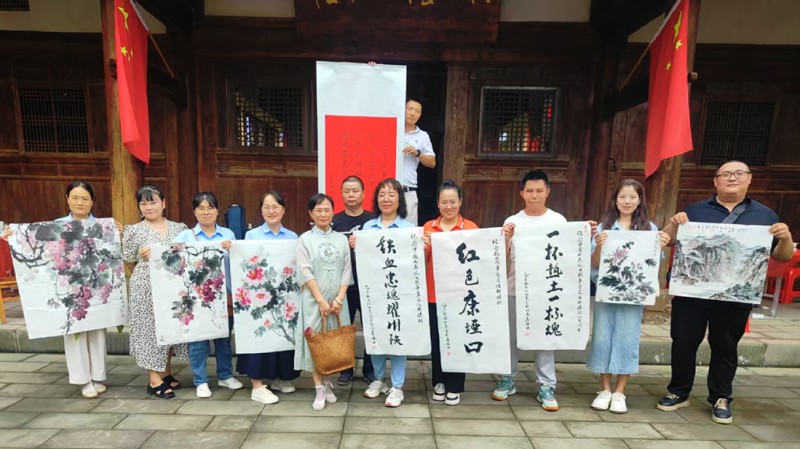
四川南充:传承红色精神 阆中
喜迎国庆——首届山里人家艺术
与文化守护同行:万茗堂202
世界馆藏级书画翘楚——齐光宏